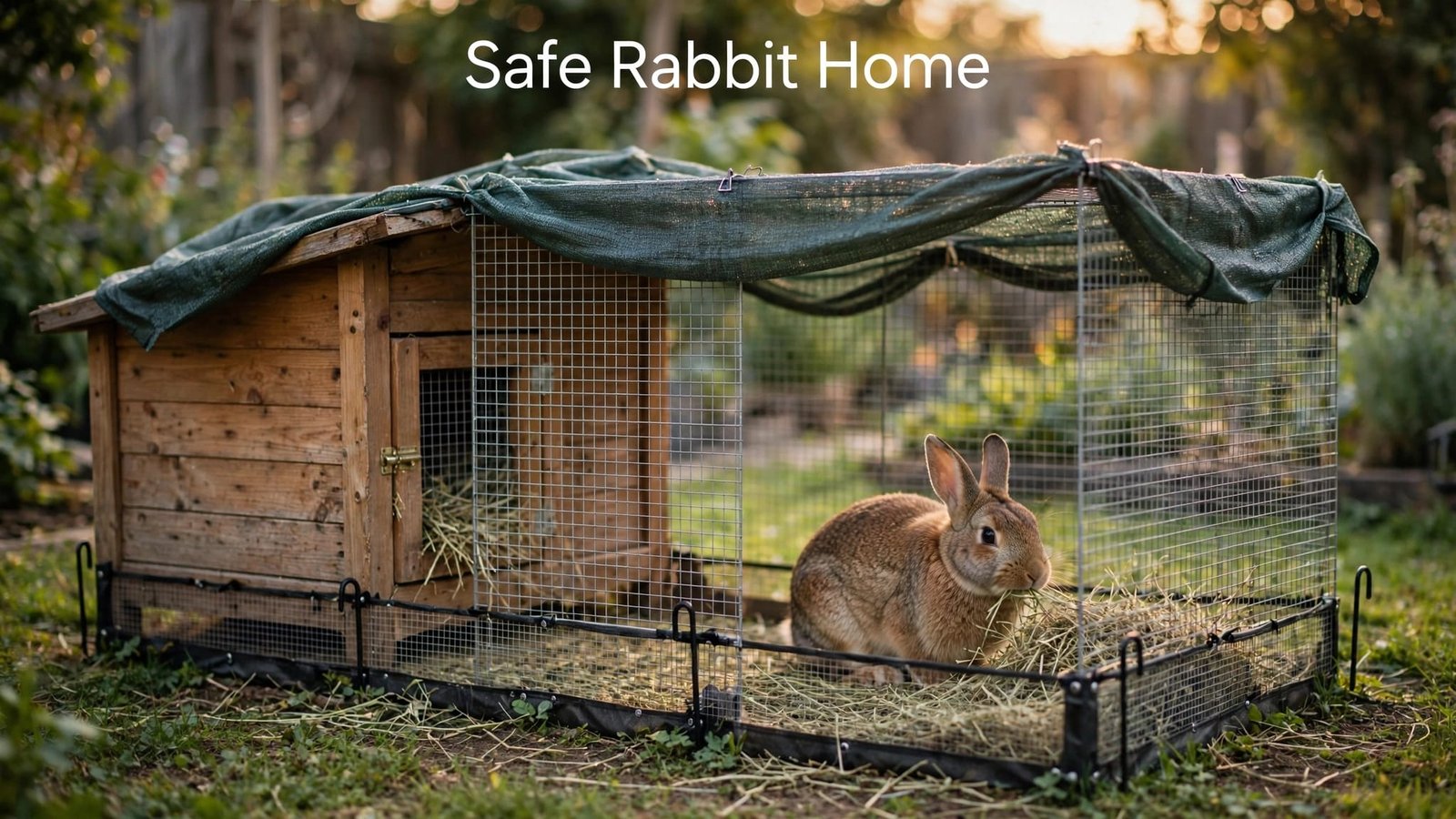
A safe outdoor rabbit enclosure needs generous usable space, secure boundaries, ground protection, and shelter suited to your yard. An outdoor rabbit cage must be part of a complete, protected setup; a hutch or ordinary garden fence alone won’t keep your bunny safe.
Your rabbit needs room to move comfortably, while every door, panel, and connection needs to resist escape and unwanted visitors. The whole setup matters, including the parts underneath and between the shelter and run.
Plan the connected shelter and run as one complete rabbit habitat, then check its construction, placement, and everyday access.
Key Takeaways
- Treat the shelter and attached run as one complete home, with secure panels, doors, roofs, and connections.
- Protect the full ground boundary against digging, including corners, doorways, and connectors.
- Leave enough clear space for your rabbit to stretch, stand, turn, and take several hops after supplies are added.
- Provide shade, protected airflow, dry shelter, stable footing, and easy access for cleaning and routine care.
- Inspect the enclosure before outdoor time and after moving or changing any part of it.
How to Make an Outdoor Rabbit Enclosure Safe
Treat the covered shelter and attached run as one complete home. A sturdy shelter won’t solve the problem if its connecting tunnel has gaps or the run has an unsecured roof.
The Rabbit Welfare Association and Fund’s outdoor rabbit housing guidance is a helpful starting point for planning the complete space. Think about how your bunny will move through it, where protection is needed, and whether you can reach every section.
Before choosing a ready-made setup, assess the finished enclosure rather than the product photograph. A wooden rabbit hutch can provide the sheltered part of an outdoor hutch, but it still needs secure connections, ground protection, and a suitable roof. A small bunny cage or stacking cage isn’t automatically a complete outdoor home.
An indoor rabbit hutch or wire cage isn’t automatically safe outdoors. An indoor rabbit moved outside needs housing designed to protect against outdoor risks.
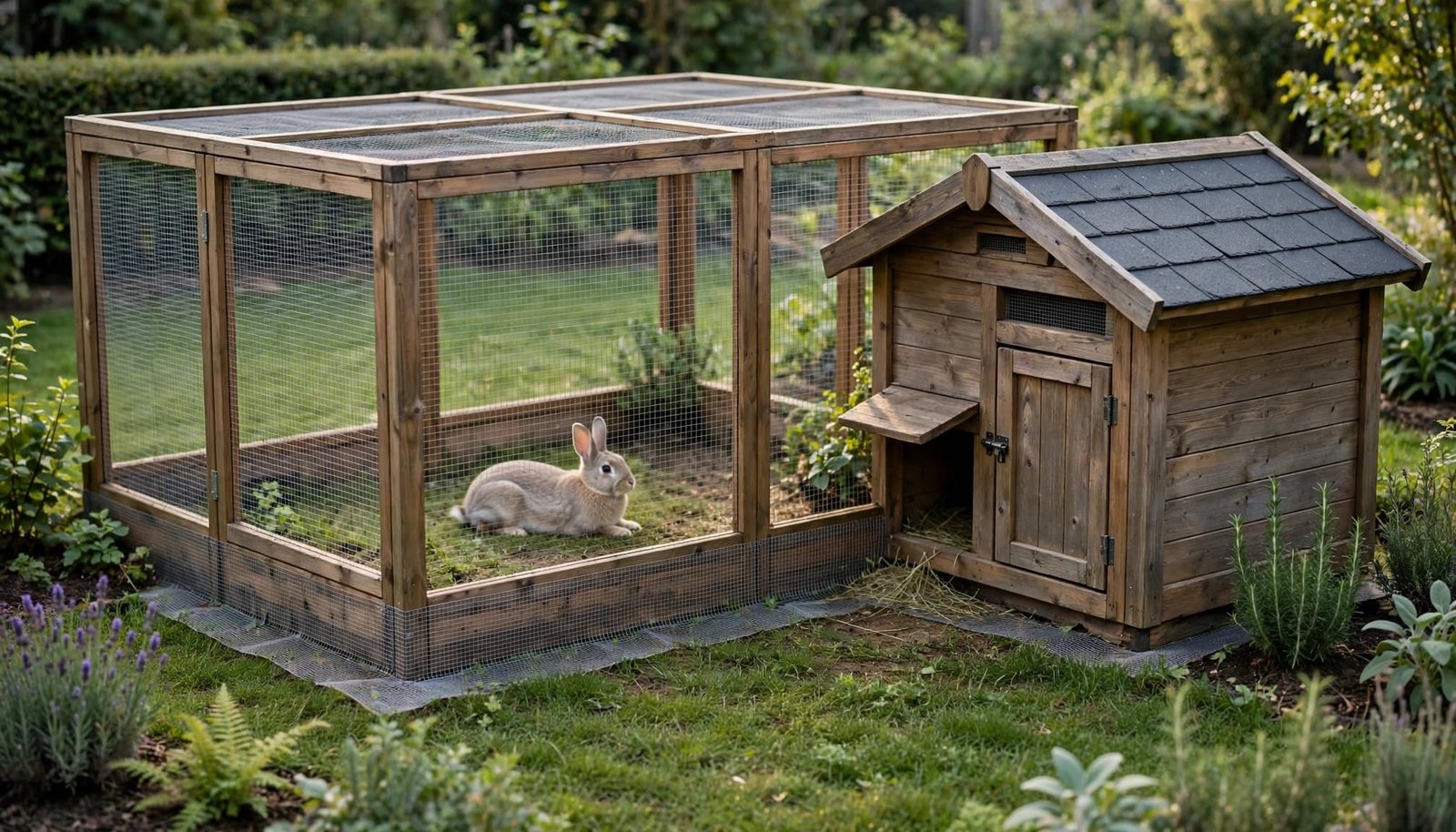
Check every panel, door, roof, and connection
Choose sturdy welded wire mesh or hardware cloth with openings suited to nearby animal risks and small enough to exclude rodents. The mesh needs secure attachment along its edges. Strong material can still leave a weak boundary when corners or seams pull loose.
Look over door frames, roof joins, flooring, and connections between sections. Cut wire ends, protruding fasteners, and sharp edges must stay out of your rabbit’s reach. Doors need dependable catches that nearby animals can’t easily push or work open.
Ordinary chicken wire alone may not resist determined predators or keep rodents out. A garden fence also leaves overhead and underground routes unprotected. The Rabbit Awareness Action Group’s predator-protection guidance reinforces the need to consider the complete housing boundary.
Check wooden edges for chewing and weather damage, too. No material should be treated as completely chew-proof, and a small damaged area deserves attention before it becomes an opening.
Protect the whole boundary from digging
Your rabbit can dig outward, while another animal can dig inward. Ground protection needs to cover the shelter, run, and connecting sections, rather than stopping at the most obvious stretch of fencing.
A properly installed mesh apron around the full perimeter or suitable paving slabs can help protect vulnerable edges. The arrangement must suit the ground and enclosure without leaving gaps at corners, doorways, or changes in level. Keep exposed wire away from hopping and resting surfaces.
Pay attention to the underside of raised shelters and the points where separate units meet. A protected run can still have an escape route beneath an unprotected connector.
If you discover a hole or damaged section, move your bunny somewhere secure before repairs. Inspect the entire boundary afterward. Filling one hole doesn’t address loose panels or another vulnerable edge nearby.
For help comparing the shelter itself, our guide to Choose a Safe Home Base covers access and usable space as well.
Leave enough room after adding supplies
Judge cage size by the room your rabbit can actually use after furnishings are added. Outside dimensions don’t show how much room walls, compartments, ramps, and accessories occupy.
Your bunny needs room to stretch out, stand upright, turn comfortably, and take several uninterrupted hops. Keep a clear route through the enclosure rather than filling every available corner. Bonded rabbits also need enough room to rest apart when they choose.
Extra levels can add interest, but they don’t replace continuous horizontal space. A large upper platform offers little help if reaching it requires a steep, awkward ramp.
Check the route between the shelter and run against your rabbit’s size and mobility. Narrow entrances and raised thresholds can make an otherwise roomy section difficult to use. A connected area only adds usable space when your bunny can reach it comfortably.
Make the shelter comfortable in changing weather
Placement matters alongside construction. Your rabbit needs weather protection, protected airflow, a dry covered resting area, and stable footing. A sheltered-looking corner may still receive strong afternoon sun or wind-driven rain.
The RSPCA’s rabbit environment guidance treats suitable shelter and protection as parts of a complete home. Look at conditions across the day before settling on a position.
Leave room around the enclosure for opening doors and reaching the roof and outside edges. A setup squeezed tightly between a fence and shed can make maintenance awkward.
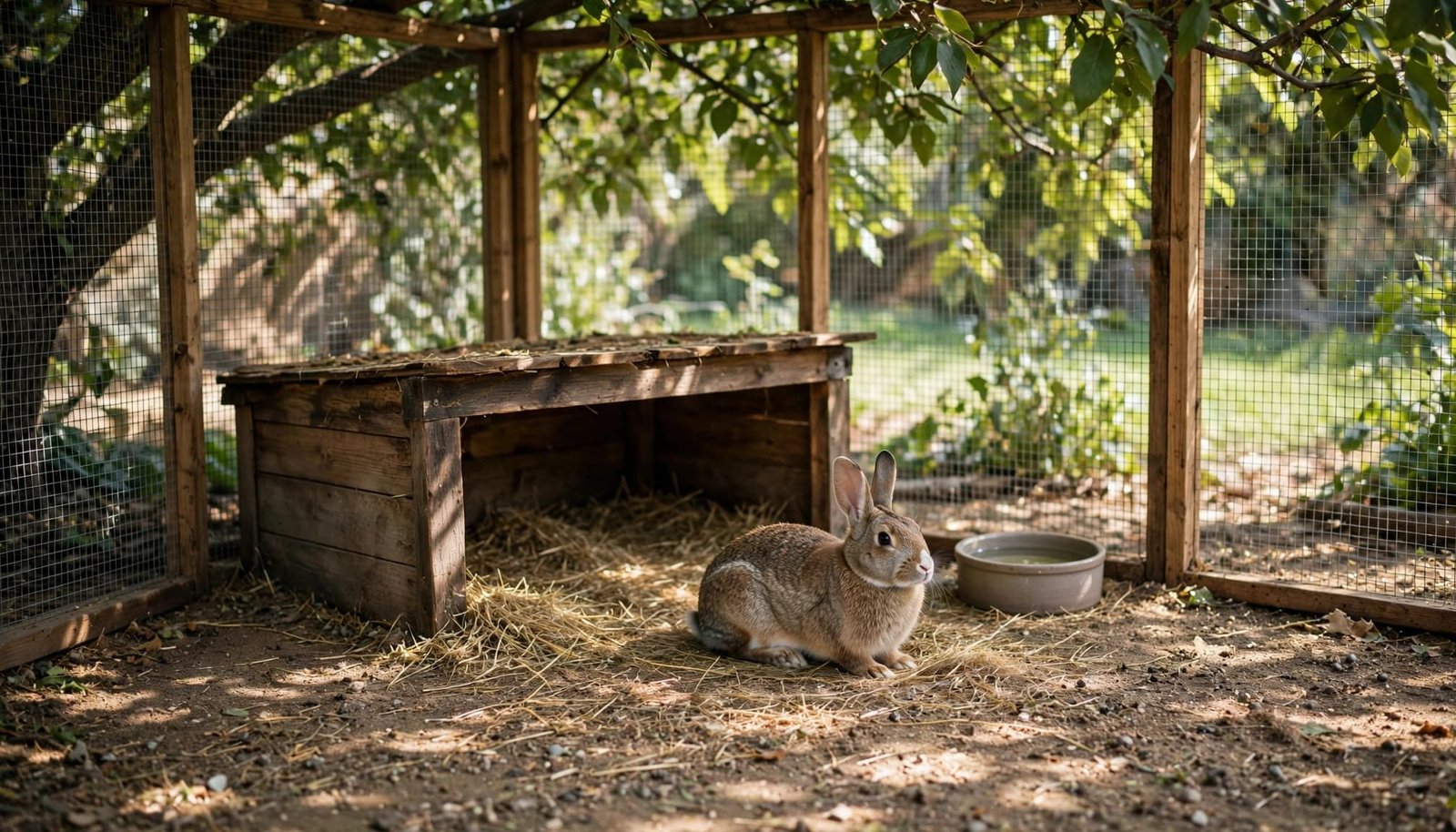
Plan for lasting shade and protected airflow
Follow the shade through your yard instead of judging the position during one morning visit. A tree or building may shade the shelter early but leave the run exposed later.
The Merck Veterinary Manual’s rabbit housing advice calls for ample shade outdoors. Make shaded space easy for your rabbit to reach, with enough room to settle comfortably rather than squeeze into one small corner.
Keep ventilation openings clear and protected against rain. Weather covers shouldn’t seal those openings or turn the sheltered area into a closed box. Look at how a cover sits when doors are shut, since its position may change during use.
Inspect roof seams and the edges above doorways for leaks. Water entering along a joint can leave the resting area damp even when most of the roof appears sound.
Choose comfortable footing and easy access
Your rabbit needs a stable surface with comfortable traction. A wire floor isn’t appropriate for resting; choose a solid floor with stable traction and a comfortable resting surface.
Grass offers a different set of practical concerns. Look for uneven ground, muddy patches, and gaps beneath the enclosure edges. Moving a run onto another patch changes the way its base meets the ground, so reassess the fit each time.
On a solid base, give your bunny a comfortable, dry resting area. Keep protective ground mesh separate from surfaces where your rabbit walks or lies down.
Consider your rabbit’s mobility when arranging entrances and sheltered spaces. An older or less-mobile bunny may find level access easier than ramps. Make sure the drop tray, litter box, bedding, and water bottle fit securely, stay clean and dry, and don’t create gaps or block access.
Keep hay in a dry feeding area your rabbit can reach, and store spare hay where it stays dry. You should be able to reach and clean each corner without taking the enclosure apart or chasing your rabbit around it. Easy access makes routine care more manageable.
Supervise outdoor time and check for hidden hazards
A secure-looking enclosure still needs attention to the space inside and around it. A garden can change between visits, especially after windy weather, gardening, or moving equipment.
The guidance on a suitable environment for rabbits emphasizes protection from hazards wherever your rabbit lives. Look beyond the main panels and consider everything your bunny can reach, push against, or become caught on.
Look inside and beside the run
Remove loose wire, garden twine, broken plastic, and sharp fragments before allowing access. Small items can disappear into grass or collect along the bottom edge of a panel.
A playpen used outdoors still needs supervision, secure boundaries, and protection from predators. Don’t assume its temporary setup offers the same security as a fully enclosed outdoor enclosure.
Check accessories as carefully as the enclosure itself. A tunnel should sit securely, and a hideout shouldn’t wobble when your bunny enters it. A hideout with two exits gives your rabbit another way through instead of creating a dead end.
Look at the space around doors, too. Garden tools, stacked pots, and storage boxes can obstruct access or make it difficult to close a door properly. Keep the working area clear enough to enter and leave without shifting obstacles.
Avoid crowding the enclosure with accessories. Your furry friend needs a clear hopping route, and you need a clear view of the boundaries. Place items where they won’t hide damage or press against vulnerable panels.
Build daily checks into your routine
Before each outdoor session, inspect the enclosure in the same order. Starting at one door and working around the boundary can help you avoid missing a corner or connection.
Look at the lower edges, then the panels, entrances, roof, and shelter joins. Pay extra attention to places your rabbit has been chewing, pushing, or investigating. Move accessories when needed so you can see behind them.
Try each catch and look for fasteners that have loosened or shifted. A door that looks closed may not be fully secured if its frame has moved out of alignment.
During cleaning, inspect surfaces that are usually hidden. Look underneath removable trays and around sheltered corners for damaged flooring or deteriorating joints.
A familiar enclosure still needs fresh attention. Yesterday’s inspection won’t reveal a new loose catch, damaged seam, or gap caused by movement today.
Reassess the setup after changes
Any alteration can affect how the enclosure works. Adding a connecting section creates new joins, while replacing a door changes the fit around its frame.
A rabbit tractor is a movable grazing enclosure, so check its boundary and ground contact every time you move it. Look for gaps at the new location before your bunny goes back inside.
After moving or expanding the setup, inspect it as a complete enclosure rather than checking only the new part. Look at ground contact, roof connections, door clearance, and the route between sheltered and open areas.
Watch how your bunny uses the layout. If an entrance is awkward or an accessory blocks movement, rearrange the space. Changes in your rabbit’s size or mobility may also call for a different arrangement.
Keep maintenance practical. If reaching a weak point requires dismantling several sections, improve access so that future inspections and repairs are easier.
Frequently Asked Questions
Is a hutch or garden fence enough to keep a rabbit safe outdoors?
No. A hutch needs secure connections, ground protection, and a suitable roof, while a garden fence leaves overhead and underground routes unprotected. Treat the shelter and run as one complete enclosure.
What should I check when inspecting an outdoor rabbit enclosure?
Check the lower edges, panels, doors, roof, shelter joins, and connections between sections. Look for loose catches, damaged seams, sharp edges, gaps, and signs of chewing or weather damage.
What kind of flooring is suitable for an outdoor rabbit enclosure?
Use a solid floor with stable traction and a comfortable resting surface. Keep protective ground mesh away from surfaces where your rabbit walks or lies down, and check that grass areas have no muddy patches or gaps beneath the edges.
How much space does a rabbit need in an outdoor enclosure?
Your rabbit needs enough usable room to stretch out, stand upright, turn comfortably, and take several uninterrupted hops. Leave a clear route through the enclosure, and make sure your rabbit can reach the connected shelter and run comfortably.
Also Read: Rabbit Enclosure: Safer, Roomier Setup
How often should I check an outdoor rabbit enclosure?
Inspect it before each outdoor session, working around the boundary and checking doors, roof, lower edges, and connections. Recheck the complete setup after moving it or changing any part.
Give Your Bunny a Secure, Comfortable Outdoor Space
A safe rabbit enclosure combines usable space, secure construction, ground protection, and comfortable shelter. Each part needs to work with the others, including the less-visible connections and lower edges.
Make a whole-enclosure inspection part of every outdoor session. Adjust the layout when your rabbit’s needs or outdoor conditions change, and deal with damage before allowing access again.
Your bunny should have room to move comfortably and a setup that makes everyday care straightforward.